“AI note-taking” now means two completely different purchases, and picking the wrong one is why people end up disappointed. One is software that thinks about notes you already have — Notion, Mem, Copilot in OneNote. The other is hardware: a small recorder you drop on the table that transcribes the room, a category WIRED reports was “massively popular at CES 2026.” Different jobs, different money. Here’s which one you actually need.
Key Takeaways
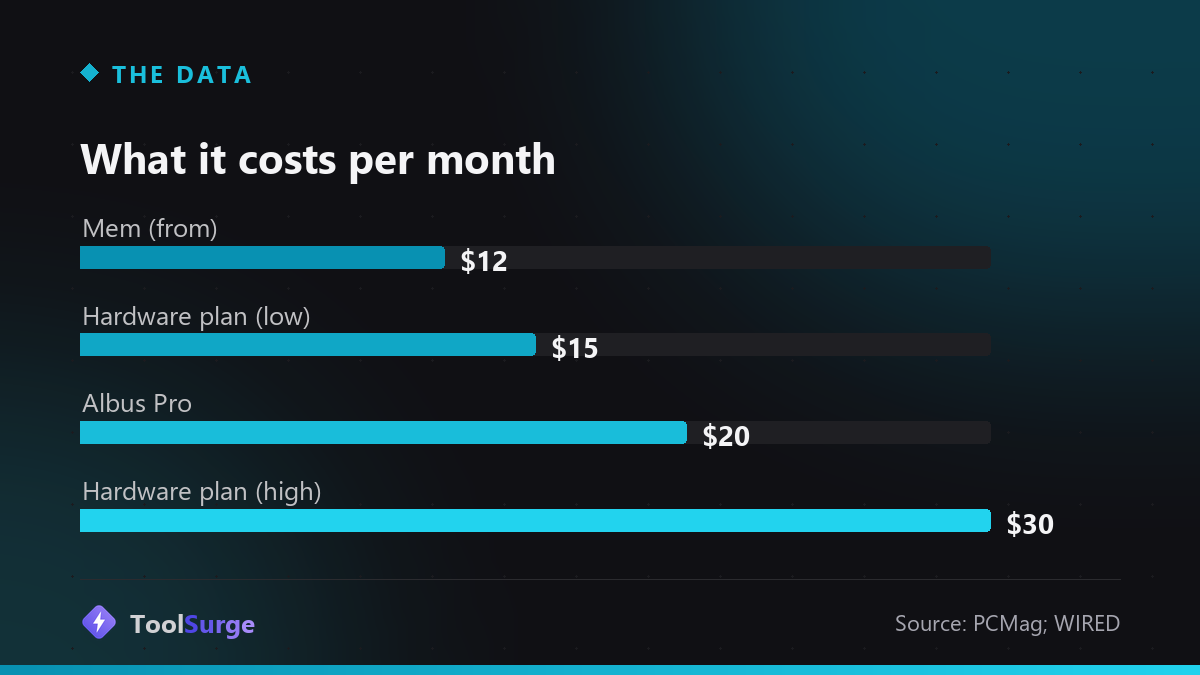
- Software prices from PCMag's testing: Mem from $12/month, Albus Pro $20/month, with free tiers on both; Notion and Copilot ride along with subscriptions many people already pay for.
- Hardware notetakers cost the device plus a subscription — WIRED found $15 to $30 per month typical for unlimited AI insights, on top of hardware like the $179 Plaud NotePin S.
- You may not need either: WIRED notes Google's Recorder app on Pixel and Apple's Voice Memos with Apple Intelligence already transcribe and summarize for free.
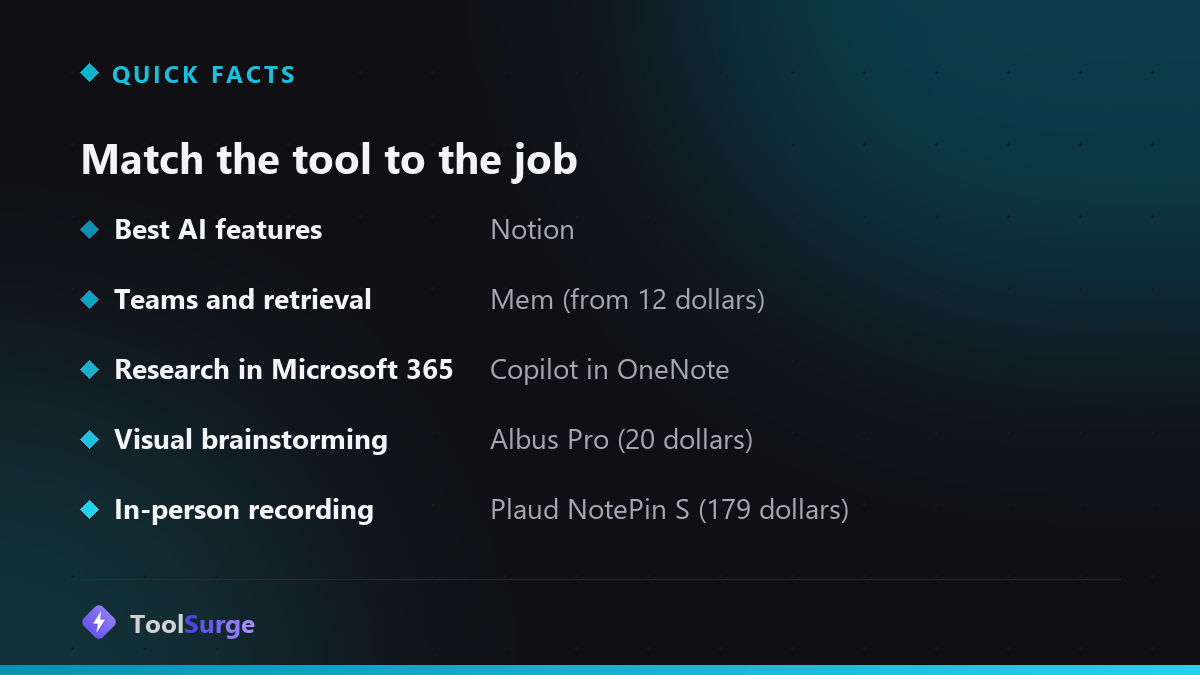
- PCMag's overall AI pick among note apps is Notion; Mem won teams, Copilot won research, Albus won brainstorming.
The software side: notes that think
Best AI features overall: Notion. PCMag’s pick for the strongest AI in a notes app, and the reasoning is about breadth — Notion’s AI answers questions about your existing data, automates actions on selected text, generates drafts, summarizes, and translates. PCMag flags two profiles it fits especially well: software workers (it’s already the team standard in a lot of engineering orgs) and tinkerers who want to customize a workspace rather than accept someone else’s.
Best for teams: Mem, free tier with paid plans from $12/month. The differentiator is contextual memory — create a note and Mem surfaces related information in a sidebar without you prompting for it. PCMag frames it as the pick for “people who hate organizing,” since the app does the retrieval you’d otherwise do by filing things properly.
Best for research: Microsoft Copilot in OneNote. If you already pay for Microsoft 365, this costs nothing extra. PCMag’s angle: Copilot sits in the Start menu and every Microsoft app, so generating notes on a topic in OneNote (or Word) takes a couple of clicks and skips a pile of manual searching.
Best for brainstorming: Albus, free tier with Pro at $20/month. An infinite canvas of sticky notes with images, text, and video, plus a chatbot you can talk to inside it. PCMag calls out semantic indexing on the paid plan — it groups your files automatically — and recommends it specifically for visual thinkers.
Best for prompting: Reflect. PCMag describes it as minimalist but feature-rich, built around ChatGPT-style prompting inside a notes app.
One caveat PCMag repeats and we’ll repeat too: fact-check AI output. A note that confidently invents a detail is worse than no note. That’s the same failure mode we covered in the best AI writing tools guide, where one tested tool cited a number that simply wasn’t right.
The hardware side: recorders that sit on the table
WIRED’s reviewer tested a range of physical AI notetakers by recording real meetings, interviews, and calls — plus the same prerecorded presentation across every device as a control — judging transcription accuracy, insight quality, speed, and value.
The pitch is simple: drop the device between you and whoever’s talking, hit a button, and an onboard mic transcribes on the fly, syncs to a phone app, then uploads for AI processing that turns a meandering hour into an outline with quotes and action items.
Why buy hardware when your phone can do this? WIRED’s answer is the awkward in-person cases — the speaker is far away or hard to hear, or you want your phone free for something else. Some devices also translate. Prices range from the $179 Plaud NotePin S up to a $1,600 Vibe Bot aimed at permanently wiring a conference room for transcription.
The subscription trap
Here’s the part buyers miss. WIRED puts it plainly: nearly every AI notetaker pushes a paid plan, most free tiers are stripped down, and you should expect $15 to $30 per month for unlimited AI insights on top of the hardware price. A $179 recorder with a $20/month plan is a $419 first year, not a $179 purchase.
Before paying either way, check what you already own. WIRED points out that Otter.ai and Bluedot handle this from your phone or laptop on Zoom calls, Google’s Recorder app has transcribed and summarized on Pixel phones for years, and Apple’s Voice Memos does the same on iPhones with Apple Intelligence. For a lot of people that’s the whole job, free.
So which should you buy?
Buy nothing yet if your notes are mostly meetings on Zoom or calls on a modern phone. Try the built-in recorder or Otter’s free tier for two weeks first.
Buy software if the problem is that you can’t find or connect what you’ve already written. That’s Notion or Mem territory, and it’s the case where AI genuinely adds something — retrieval and synthesis, not transcription.
Buy hardware only for in-person situations your phone handles badly: lecture halls, noisy rooms, long interviews where you need the phone free. Budget the subscription, not just the device.
The broader pattern, as a16z’s 2026 look at AI apps argues, is that the value is moving from generating text to organizing context — which is exactly why the “notes” category got interesting this year. If you’re picking a general assistant to sit alongside any of these, our ChatGPT vs Claude vs Gemini comparison covers that call.
What happens next
Two things to watch. First, consolidation of the hardware field: WIRED’s August 2026 update alone added notetakers from Soundcore, SpeakON, Looki, Flowtica, Vocci, and iFLYTEK, with Omi, Boya, Mobvoi, and SwitchBot on deck. A category adding that many entrants in a year usually sheds most of them, and an orphaned recorder whose cloud service shuts down is a paperweight — buy from vendors likely to still exist in 2028.
Second, the free floor keeps rising. Every capability that Apple and Google fold into the default recorder app is one fewer reason to pay a subscription, and both are shipping those features to hundreds of millions of phones. The paid tools will have to justify themselves on the thinking layer — retrieval, synthesis, connecting notes to your other work — rather than on transcription, which is becoming a commodity.
Quick poll
How do you capture meetings right now?
WIRED's advice before you buy hardware: check whether your phone already transcribes and summarizes for free.
FAQ
What’s the best AI note-taking app in 2026? PCMag’s overall AI pick is Notion, with Mem best for teams (from $12/month), Copilot best for research if you’re in Microsoft 365, and Albus best for visual brainstorming ($20/month Pro).
Are AI voice recorders worth it over a phone app? Only for specific situations, per WIRED: the speaker is far away or hard to hear, or you need your phone free. Otherwise phone-based options like Otter, Bluedot, Google Recorder, or Apple Voice Memos cover it.
How much do AI notetakers cost per month? WIRED found $15 to $30 per month typical for unlimited AI insights on hardware notetakers, charged on top of the device price. Software plans start lower — Mem from $12, Albus Pro at $20.
Can I use AI note-taking for free? Yes, within limits. Most apps have stripped-down free tiers, and phone built-ins (Google Recorder on Pixel, Apple Voice Memos with Apple Intelligence) transcribe and summarize at no cost.