Here’s the fast answer: for most people, ChatGPT is still the best all-round AI writing tool in 2026 — but it stops being the right answer the moment your writing gets specific. Serious long-form work is where Claude pulls ahead, marketing teams get more from Jasper, and novelists have a purpose-built option in Sudowrite that generalist chatbots don’t really compete with. We went through every official pricing page this week so the numbers below are current, not copied from last year’s roundups.
Key Takeaways
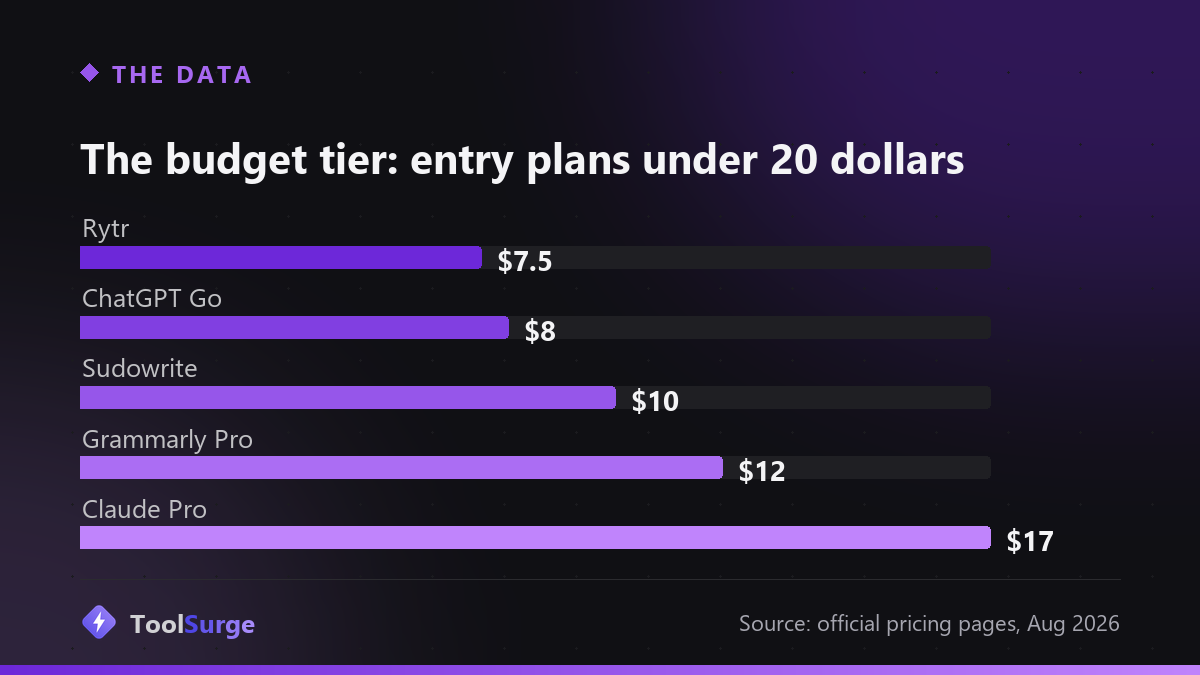
- Entry prices as of August 2026: Rytr $7.50/mo, ChatGPT Go $8, Sudowrite $10, Grammarly Pro $12, Claude Pro $17, ChatGPT Plus $20, Jasper Pro $59 — all from official pricing pages.
- In Tom's Guide's head-to-head writing-coach test, Claude understood story structure at the deepest level, while ChatGPT won on line-level timing and Gemini gave the clearest actionable advice.
- Jasper and Sudowrite justify their prices only for their niches — marketing teams and fiction writers respectively; everyone else is better off with a generalist chatbot.
- Writesonic no longer competes here: it has pivoted into an AI search-visibility platform starting at $79/month.
How we ranked them
Two rules. First, every price below comes from the tool’s official pricing page, checked this week — August 2026. Second, quality claims are attributed to published hands-on testing (Tom’s Guide, PCMag, Slack’s team-tools evaluation) rather than vibes. Where a tool has an affiliate program we may earn a commission through our links — it never changes the order of this list, and the full policy is in our disclosure.
Best overall: ChatGPT — the default for a reason
For sheer breadth — emails, essays, code comments, cover letters, meeting agendas — ChatGPT remains the tool to beat. PCMag’s ChatGPT-vs-Claude comparison gave it the win on price, noting paid plans start at just $8/month for ChatGPT Go while Plus runs $20, and that its free tier includes features like deep research that rivals gate behind paywalls. In Tom’s Guide’s writing-coach test, ChatGPT “zeroed in on the rhythm of the piece” and delivered precise, immediately usable line edits.
Its weakness, per the same test: it polishes moments rather than interrogating whether the whole piece works. If you’re torn between the big three chatbots, our full ChatGPT vs Claude vs Gemini breakdown goes deeper than this list can.
Best for serious drafting: Claude — the structural editor
When Tom’s Guide handed the same comedy draft to three chatbots, Claude was the one that “understood the story on a much deeper level” — identifying the central joke’s architecture, explaining why seemingly random details belonged, and spotting a story hole the other two missed entirely. That structural depth is exactly what you want in a drafting partner for essays, scripts, and anything longer than a page.
Claude Pro costs $17/month billed annually ($20 monthly), and per the official pricing page now bundles Claude Code and Claude Cowork. PCMag notes Claude can’t generate images — but it builds HTML visualizations ChatGPT can’t match.
Best if you live in Google: Gemini
Gemini’s feedback was “the easiest to absorb and apply” in Tom’s Guide’s coaching test — direct, specific, low-interpretation advice. Its real argument, though, is bundling: it’s woven into Gmail, Docs, and Google’s storage plans, and Google’s AI subscriptions now ladder from an entry tier up to AI Ultra at $100–$200/month for power users, per Google’s official announcement. For quick, clear revisions inside tools you already use daily, it’s the path of least resistance.
Best for marketing teams: Jasper
Jasper is no longer trying to be everyone’s chatbot — it’s marketing infrastructure. The Pro plan runs $69/month per seat ($59 annual), and the official pricing page leads with brand voices, knowledge assets, audiences, and marketing-workflow agents. Slack’s team-tools roundup highlights its multilingual output across 30+ languages for on-brand content at scale. Solo writers shouldn’t pay this; content teams shipping campaigns in three languages absolutely should run the trial.
Best for fiction: Sudowrite
Sudowrite is the only tool on this list built for novelists first. Pricing starts at $10/month for hobbyists (225,000 credits), with the popular Professional tier at $22 and a $44 Max tier for prolific authors with 12-month credit rollover, per its pricing page. It’s credit-metered rather than unlimited — the trade-off for features generalist chatbots don’t have, like long-work feedback tuned to manuscripts.
Best budget pick: Rytr
At $7.50/month billed annually for unlimited generations, Rytr undercuts everything above it. The official pricing page’s free tier (10K characters/month) is enough to test whether short-form AI drafting fits your workflow at all, and Unlimited adds tone matching and 50 plagiarism checks monthly. You give up the deep reasoning of the frontier chatbots — for social captions and product blurbs, plenty of people won’t notice.
The editing layer: Grammarly
Grammarly isn’t a drafting tool; it’s the quality gate that sits on top of whichever one you pick. Free covers spelling, grammar, and tone; Pro at $12/month adds full-sentence rewrites, unlimited personalized suggestions, and — notably — plagiarism and AI-text detection, per the plans page. That last feature is quietly becoming essential for anyone publishing AI-assisted work professionally.

What changed in 2026: Writesonic left the category
If you’re following an older roundup that recommends Writesonic as a budget writing tool, know that it has reinvented itself as an AI search-visibility platform — tracking how brands appear across ChatGPT, Gemini, and Google AI Overviews — with plans now starting at $79/month. Its pricing page still includes AI article generation, but the product’s center of gravity has moved to marketing analytics.
What happens next
Two trends worth watching. First, bundling is accelerating: Claude Pro now packages coding and automation agents, Google folds Gemini deeper into Search and Workspace — see what that looks like in Google’s new agentic booking push — and OpenAI keeps widening what the $8 Go tier includes. The “writing tool” category is dissolving into general AI assistants at the low end. Second, the specialists are betting the opposite way: Jasper’s per-seat marketing platform and Sudowrite’s craft features assume depth beats breadth. Prices moved several times in the past year; we’ll keep this list pinned to the official pages.
Quick poll
What do you mostly use AI writing tools for?
Our take: match the tool to the job — the $69 tool is overkill for email, and the $8 one will frustrate a novelist.
FAQ
What’s the cheapest way to get real AI writing help in 2026? Rytr’s Unlimited plan at $7.50/month (billed annually) or ChatGPT Go at $8/month. Grammarly’s free tier is the best zero-cost editing layer.
Is Jasper worth it over ChatGPT? Only for marketing teams. Jasper’s $59–69/seat pricing buys brand voices, audiences, and workflow agents — Slack’s roundup positions it for multilingual, on-brand content at scale. For individual writing, ChatGPT or Claude does more for a third of the price.
Which AI tool is best for writing a novel? Sudowrite is the purpose-built pick ($10–$44/month, credit-based). Among generalists, Tom’s Guide’s testing found Claude strongest at story structure — it caught a plot hole ChatGPT and Gemini both missed.
Do these tools detect AI-generated text? Grammarly Pro includes both plagiarism and AI-text detection per its plans page. Most drafting tools don’t — they generate, they don’t police.